Fasteners
Screws, Bolts, Nuts, Loctite and More.
www.cjbyron.com
|
Fasteners
|
|
Introduction
(or: what is the intention and the area or method of application?)
First of all let me state that I am not a "bolt scientist". There is a huge amount of information online and in books that exceeds what I know or you will find here. It can be a very detailed and complex science (think Space Shuttle!). So who am I? Well, all of the following is just what I have learned and applied over years of working with machinery fasteners in various applications including mission critical and life safety applications. Meaning fastener failure could cause severe loss and/or injury/death. Due to that, fastener data knowledge and application on a scale beyond ordinary conditions was required. So the information and viewpoints are from the specialized rescue field working for the government as well as working with high speed race cars too.
Application herein is mostly towards the 3000GT VR4 as that is where a majority of questions in my email box come from these days.
Certain topics come up time and again in automotive performance or fabrication discussions. These are some of those topics and what I have learned over the years from experience, research, and trial/error (aka – failure but luckily that is kept to a minimum by doing things right as much as humanly possible).
Many of the issues discussed here do apply to 'mission critical' and/or safety applications such as the engine, transmission, brakes or so on. It is not about installing a stereo or something similarly benign. Instead they deal with possibly avoiding engine failure, or brake failure, or other 'fastener failure' that could be catastrophic financially or cause serious injury or death in the event of failure at high speeds.
Some of the info here is not car specific in nature but I may, in some instances, apply it to the 3000GT VR4 platform specifically (and may use the term "3S" to denote the 3000GT or equal). I may not go into detail in some areas because there is an abundance of more detail in the reference pages or other websites. I also wanted to have it is basic laymens terms and not dozens of pages of technical jargon. I have tried to maintain the right terminology however to match to the more scientific sites if you are so inclined.
*
If you want more detail jump to the reference pages for a list of some nice sites that do go into further detail or scientific theory and application.
Using the proper fastener (and why sometimes OEM is the only proper to go)
One example of doing things right is using the proper fasteners (bolts) to the proper torque specs and application. Much has been written already about torque specs, using which fasteners (or not) as well as the science behind bolts and automotive fasteners in general. Some links for more details can be found in the reference portion of this site.
Let me start by saying that all bolts are not equal. They can look identical but be very different. Seems like a simple statement but one that must be paid attention to. While in some situations a replacement from the hardware store might be fine there are several other situations where it will NOT be fine and could even cause total failure of your application.
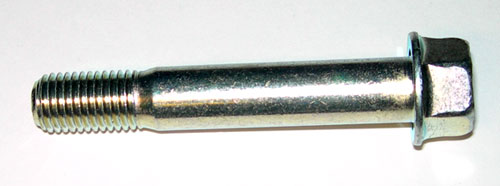
A good 3S example of the reason to stick with OEM only bolts is the timing belt tensioner bolt(s). Here is a photo of this bolt. |
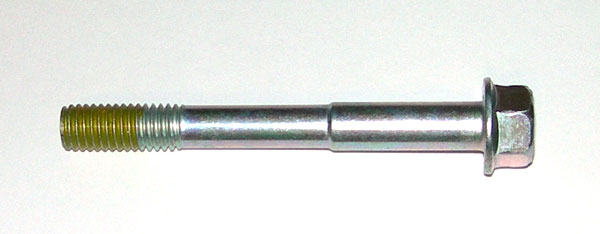 (Mitsubishi Part #MD173607 for Hydraulic Tensioner) |
See the difference in the shoulder length? And it has an anaerobic sealant applied at the factory. Per OEM specifications (see the Factory Service Manual, aka - FSM) this bolt is to receive a thread sealant due to its penetration into the block/oil galley. This is why a replacement bolt will have that anaerobic sealant applied. And a note: Sealant is not the same as a thread locker. Totally different (see loctite page).
Clean and Dry
The FSM torque specs for all fasteners are based upon a clean, and DRY fastener. Unless otherwise noted in the FSM of course (i.e. – headbolts w/ engine oil). Do not oil your bolts or put anything on them unless it is specifically called for in the FSM. No oil, no anti-seize (worse than oil!), and clean them off if they are oily, dirty, etc. It is quick and easy,
A major part of a fasteners torque spec is in the friction of the threads when tightening. Only a percentage of the torque applied is transmitted to the bolt preload itself. If you add a lubricant you change what is called the K factor thereby changing the torque being applied to the fastener/bolt. You are looking to apply what’s called preload to the bolt so that it stays in place. In laymens terms you are stretching the bolt material (usually steel) to the point it will hold in place. Too much and you will over stretch (over-torque) and permanently damage the fastener/steel. Too little and it will move and cause wear which will also eventually render the fastener useless.
So if you want to achieve accurate and as intended torque specification then use only clean dry bolts. A lot of technical work was done by the manufacturer to determine the right torque on their engine, transmission, etc. Putting any oil, antiseize, or other lubricant on them can change your applied torque as much as 20-40%. Sometimes enough to cause the failure of the fastener or related assembly.
On performance engine rebuilds I take all the fasteners and put them in a heated ultrasonic cleaner to get them all nice and clean. This removes any residual oil and gunk built up on the fasteners and I am then assured of clean oil-free fasteners in the reassembly of the engine. A person could just use some brakleen, solvent tank, etc. too but I like the ultrasonic cleaner method because it REALLY cleans them all up nicely. It also saves a lot of time. Fill the basket up, turn it on, come back a little later and your bolts, nuts, etc. are all maximum clean. You'll be surprised how often you'll use it for various things and not just bolts or other fasteners. I use a SHARPERTEK professional cleaner and you can get a good one for under $300. Some might recommend a tumbler like from Eastwood or similar suppliers. However the tumblers don't clean the threads like an ultrasonic cleaner does and it also can remove anti-rust coatings on the fasteners (which you do not want to do). Choosing the right solution is important and I opt to go with one that is not too agressive. Most of the time I am not cleaning of things that are really greasy or rusty, etc. So a general cleaning solution works best without harming any fastener corrosion coating. Simple Green 50/50 works pretty well too and is readily available most anywhere (you don't want to use anything flammable!). |
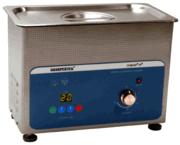 professional quality heated ultrasonic cleaners can be obtain for a fairly low cost |
Digital Torque wrenches and Stretching bolts (past their limits)
 |
I use all digital torque wrenches. My personal preference is the Snap-On brand. Part of the advantage of using a digital wrench is you can see when a bolt stretches. You can also read the torque required to remove a fastener should this information be needed. |
On many cars I have seen certain bolts stretch when trying to apply the proper torque. With the digital wrench you see it get up to the torque value (or sometimes it can’t reach it) and then fall right back off again. The fastener had been over-torqued (stretched) past it’s point of being able to rebound or recover. Basically the bolt is ruined and belongs in the garbage. Once you get used to the readable (digital) torque style wrenches it becomes very easy, and quick, to catch a stretched bolt. You cannot catch these with the click style. You could keep trying to torque by repeated use but you will just end up stretching it more and eventually just breaking it completely.
When I see it happen on someones car I attribute this stretching of the bolts past their ability to recover to previous owners or mechanics that over-torqued them. And usually it is from using bolts that are oil soaked plus either not using a torque wrench or using one that is not properly calibrated. Or both. So the bolt was tightened past it’s acceptable preload point and ruined. This can happen more often if the bolt in questions is very close to it's failure point to begin with.
| Some common bolts that I see stretch often (on the 3000GT) are the water pump bolts, oil pump bolts and some of the timing belt pulley or tensioner bolts. Since some of these bolts have some unique characteristics (see tensioner bolts example photo above) regarding their shape, shoulder, length, etc., I keep extra brand new OEM bolts on hand just for this reason. |
Whenever doing a 60k or 120k tuneup or just servicing in general these bolts should be replaced if there is ANY question as to their integrity. Remember that a $3 tensioner bolt failure can cause thousands of dollars damage when it fails.
Another common area of damage or leaking is overtorquing the oil pan and valve covers. The torque value is very low on the matching of the machined (ie – rigid) surface to the stamped surface (the oil pan). Many people go way too high on the bolts here. My advice is to use your torque wrench unless you are very good at knowing what 2, 3, or 4 ft/lbs feels like. Few people are. What can happen is you will warp the stamped metal so basically you will ruin the flat surface needed to mate to the machined surface. Enough to leak? Yes, sometimes it will be enough to cause a leak. More so the valve cover just due to the nature of gasket vs. RTV/sealant only on the oil pan application. But in general the above example is just another of how improper tightening can affect your task.
 Above - Mitsubishi Part #MD145360 for Tensioner Bearing (pulley) Pivot/Bracket. Flat Washer MD145169 and Delrin Bushing MD145168 are separate. The bolt for the pulley itself is MF244884 and includes a flat and split washer on it |
So unless specifically indicated or called for: No oil, lube, antiseize, or grease….. CLEAN AND DRY. |
If you can, clean out the threads of what the bolt is fastening too also. In this way you will get the right torque and your fastener will perform as required. Depending on the fastener it might be critical to the life or health of the entire engine (or transmission). And while not all applications require this much attention some applications, such as on a 1,000+ race engine, do. Plus good habits are always a plus. See chart below in the Anti-Seize section that helps graphically show this information (TORQUE TENSION EFFECTS OF LUBRICATION).
Bolt Property Classification (Class)
The term 'class' is similar to GRADE except GRADE is used for SAE bolts whereas METRIC bolts are rated by CLASS. The reference pages have some samples of the head markings for the different classes as well as tensile strengths, torque ranges etc. That information is not included here because it is reference material.
Basic Premise of Metric ISO Marking
Metric fasteners are marked with two numbers separated by a decimal point, like 10.9. The 10 is 1/100 of tensile strength in MPa, and the .9 represents the ratio of yield to tensile strength. So 10.9 represents a tensile strength of 1000 MPa and yield of 900 MPa.
The numbers on the bolts on the 3000GT, such as 7 or 8, are not standard ‘class’ numbers (aka – ISO property classification). The best matchup I can see if you must guess and replace a factory bolt with an aftermarket one is this:
Number on the Head of the Mitsubishi Bolt |
Approximate matching Property CLASS |
4 |
4.6-4.8 upwards to 6.9 (unusual classes if using a hardware store vs specialty supplier) |
7 |
8.8 (similar in strength to what an SAE guy refers to as a Grade 5) |
8 |
9.8 (again, not a common class for hardware store or similar suppliers. You’ll have to go less to 8.8 or go up to a class 10.9. Adjust torque accordingly) |
10 |
10.9 |
To get more exact you can look up the recommended torque value of the bolt/screw and match it to the ISO class a little closer to get the right bolt. However, many bolts in the lower classes do not hold critical components or you can go with the estimate as referenced above and be perfectly within tolerances. Plus some are harder to find (such as class 6.9, 9.8, etc) so you just go with the next class up from the hardware store and adjust your torque value based upon the bolt you are using. If in doubt one thing will address it completely - use the OEM intended bolt and intended torque specification. Which leads into another mistake I see occur.........
Replacing with a Stronger Bolt?
Is it a good idea or better? It depends on your application but in general when working with predetermined OEM specifications - No, not really. Especially if you do not adjust for the increased torque value needed to put the same preload on the fastener/bolt. Remember that the torque value you see in the FSM is based upon the OEM bolt. Which might be in the 4.8 class. So that particular bolt, let’s say, has a value of 24 ftlbs to proper torque (ie – exert the proper amount of preload to make the fastener hold). If you replace that same bolt with a class 10.9 let’s say, then apply the same 24 ftlbs to the fastener then it is not anywhere near the torque value needed to apply the same preload that a 10.9 class bolt needs. End result is the bolt will come loose from under-torquing and can even be ruined by undertorquing due to fastener movement.
This is one of those “Hmmm, never thought about it but now that I have it makes perfect sense” type of things. All grades (or classes) of fasteners have a torque value that is best (aka yield point). You want the right torque to apply the clamping force you need but do not want to reach the tensile yield strength because the bolt cannot recover from that amount of force (ie- elastic region versus plastic region of the bolt which is the permanent deformation region). There is no shortage of charts online where you can find the recommended torque value for a certain grade or class of bolt. The best kind (and most accurate) also include a sizing value adjustment as well as K factor to apply. But the result for this is example is the same – higher class bolts require more force to preload them sufficient that they do not come loose. That’s the simplest way I can think of to say it.
So – Do not replace a bolts or fastener with a different grade/class without considering the change in required torque to achieve the same preload required to do the job intended.
It will fail. A ‘stronger bolt’ is not 'better'. If you understand the many concepts involved then yes it is possible but in general it is inadvisable. And, it seems, most people do not take these concepts into account. Stick with the proper classification of bolt and you will be fine. If you really MUST go with an aftermarket bolt then use some due diligence and factor in the possible differences of class/yield point as well as material (zinc coated steel? Or something else? Different friction here means different torque results).
Don't Forget about your Nuts
Nuts are also graded so using the right grade or class of nut is important as well. Do not mistakenly use a nut from a class 5 application onto a class 10 bolt (just a random example). Most hardware stores carry 'hardened' nuts if you need something a step up to match your higher class/grade bolt. And while there is a system for marking nuts as to their tensile strength many nuts do not have those markings on them except in special applications. Just be aware that nuts, just like bolts, are not all the same regardless of what they look like. Some people worry all about the bolt classification or tensile strength only to turn around and tighten it down with a weak nut which completely negates the use of the selected bolt.
So keep this in mind, especially when working on a nut/bolt arrangement that requires high clamping forces and/or failure would have serious consequences. In an OEM situation, if you don't know the difference in the nuts by their characteristics and application, put the same nut back with the same bolt rather than mix them all up.
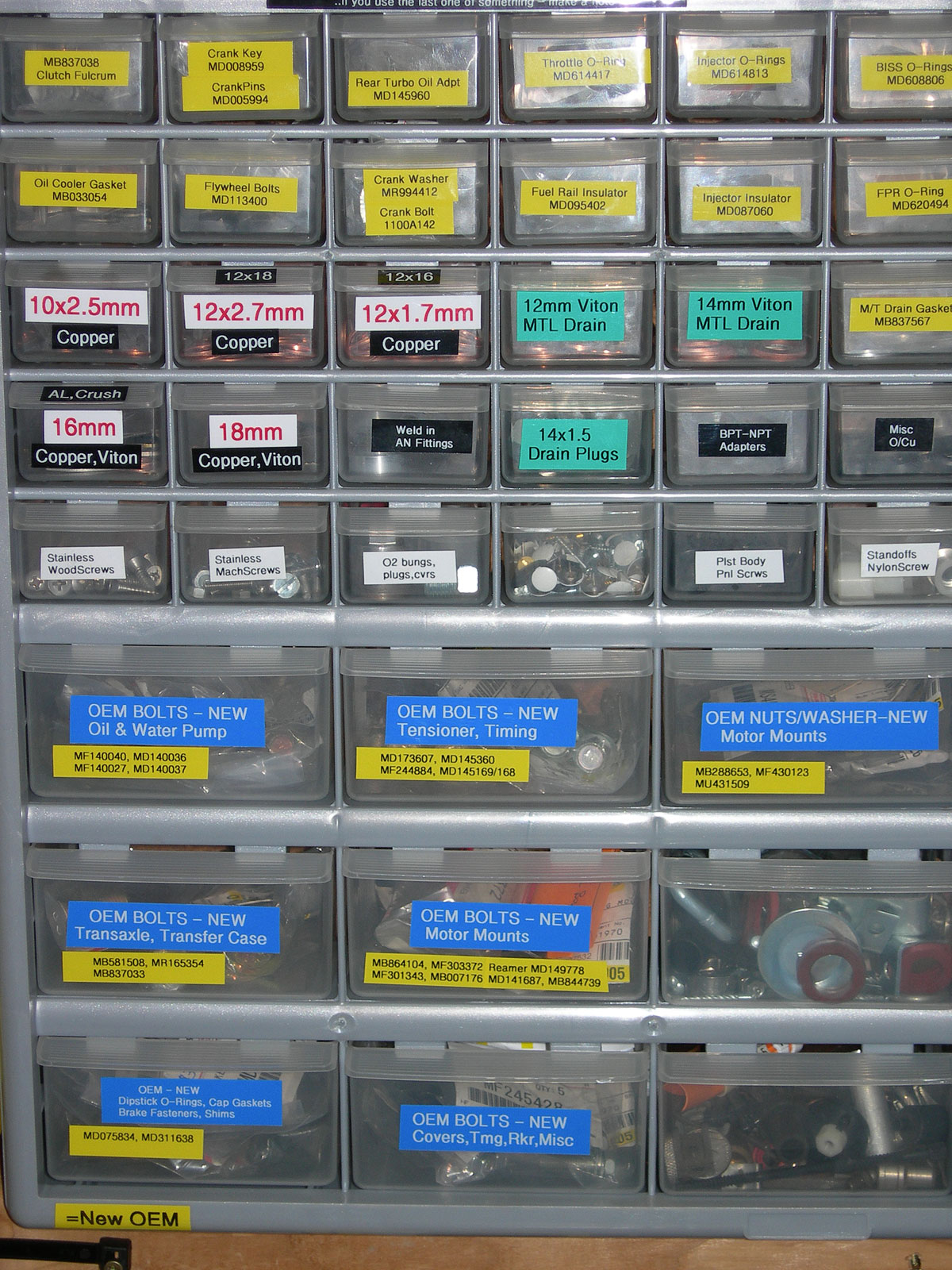
Here is my main nuts, bolts and other fasteners bins in my shop
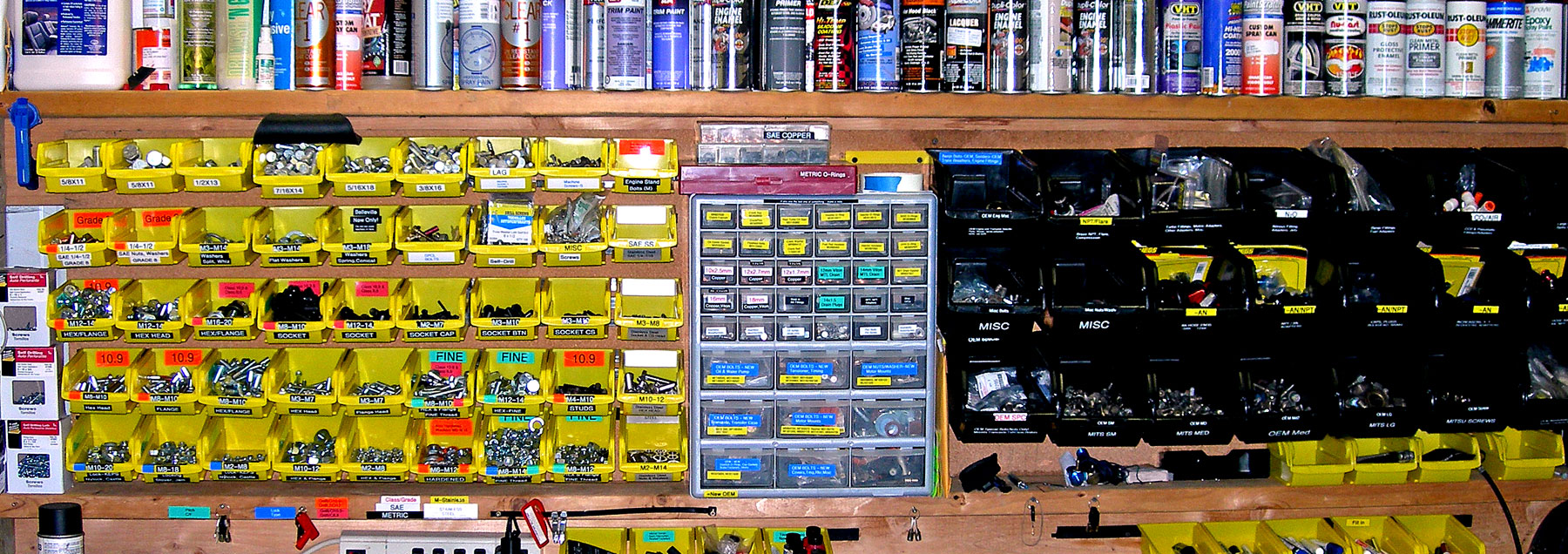
click image for larger view in a new window
Stainless Steel is better right?
This is something that I see with “engine dress up kits” or similar. Stainless steel (SS) is nice looking. No doubt about it. But is it a good idea to put it on your cars engine or elsewhere? Usually not and is why the manufacturer did not do that in the first place. And it isn’t always strong enough either (see the tensile strength comparison charts in the reference area).
One thing that people need to know is something called galling. Also called cold welding. There is a reaction between SS and other materials (like Aluminum) that will result in a process that will seize the SS fastener into the other metal. The result is torn out threads in the (again, especially Aluminum) portion. If you must use SS fasteners then use a proper anti-seize. This is one of the few instances where anti-seize (AS) is indicated for a fastener under preload (more on this later). Use one that is zinc or nickel based. Stay completely away from any AS that has graphite in it. it can be very harmful to the opposing metal, like aluminum, and can also cause some reactions with SS too. There are some specific reference articles on this very topic (i.e. - graphite in anti-seize products and use on types of metals).
IF CHANGING FASTENERS IS YOUR THING - Or you want a different look whether it be socket cap screws (aka allen head bolts), torx bolts, or other like nickel plated or chrome - here are a couple places that carry alternate fasteners at great prices and large selection that go beyond your local hardware store:
McMaster-Carr - Has a LOT of choices and different specifications, strengths and uses. Including grade 9 bolts (aircraft grade), torx, Grade 8 and 8.2 black oxide, real good prices on socket cap screws, and also wire lock bolts (drilled for use with .032 safety wire).
Allens Fasteners - nice selection of gold (zinc chromate) high torque cap screws and botls, also a good selection of fully chromed bolts, including socket cap too.
Both those places have very reasonable prices IMO. You can usually obtain all your needs there for much less than some other places or in kit form and yuo'll probably end up with a higher quality of fastener also. Just remember to take into account the grade (or class for metric) and adjusting torque as needed if using an anti-galling lube or AS.
ANTI-SEIZE
This product is misused more often than not. It has it's place in things like certain dissimilar metals joining (such as noted above) but for the most part it should never be used on fasteners (bolts) that are holding a load. There is a lot of information and technical studies that show without a doubt that using antiseize will cause bolt failure. Essentially it causes the preload to be lost.
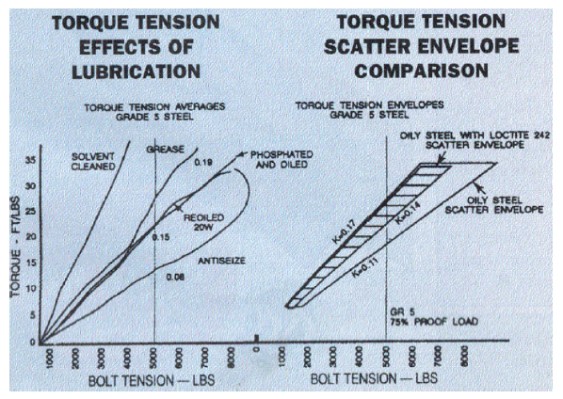
ref: the Henkel Corporation
Not all AS is the same either. Look at the content. Zinc based is very common and a good all-around choice as is the copper based. Nickel based is best for high heat environments as it can withstand much higher temperatures. Stay away from anything with graphite in it. In fact I'd go so far as to say through it away if it is graphite based. Here is a few other statistical tables:
Surface
treatment
|
Wrench
torque lb. ft.
|
Axial
Force (lb)
|
Antiseize
on whole length
|
137.5
|
36,080
|
| Antiseize
on threads only
|
137.5 | 24,440 |
No
antiseize
|
137.5
|
25,706
|
For more details on anti-seize usage and data see the reference pages.
Let me say that I do not “have a horse in this race”, meaning if you want to put anti-seize all over everything be my guest. There are persons out there that subscribe to type of thinking when using fasteners, especially on cars or trucks. What I am pointing out however is that the current science (tests, proof, metallurgy, etc) shows that it is not a good idea to use it on all your fasteners as it can have a detrimental effect on the intended purpose of the fastener. Especially in non-load bearing instances. It has a very specific, and limited, use when applied to automotive applications. All the car manufacturers agree (as per just about every service manual which specifies clean and dry for most fasteners). Same with spark plugs – many claim a good idea to use it on spark plug threads into an aluminum head (or even otherwise) but the major spark plug manufacturers say no. Mainly because the threads are already a type of material (ex: nickel alloy or treated) that prevents galling all on its own. And on lugnuts there has been numerous occurrences worldwide (fully documented) where using antiseize was determined to have been the cause of them coming loose. Yes, there is always the guy that says he’s been “doing it for 40 years” or whatever and never had a problem. Well, that’s like saying you get drunk every weekend and drive home and have never been in a wreck. That doesn’t make it a good idea or something people should do. To me it isn’t an argument for doing something especially in the face of scientific proof, manufacturer recommendations, or other such tangible data. The only other thing I’d add is if you do want to use it then try and avoid the other mistake which is using way too much. It only takes a fraction of what most people slop onto the threads. For me I base my decisions on sound testing, science, and information from worldwide fastener companies. Such as Henkel Company (parent company for Loctite corp), GM, Ford, Boeing and other aviation sources, NASA, and so on. Henkel has done extensive testing and studies which show what I referred to (that it is not a good idea to use A.S. in many instances) as well as NASA. So that’s just my views and sources and I am only passing the information along with the intent of sharing information that will help others determine the decision and use that is best for them (as opposed to advice based upon “having done it for years without ill effects”, at least known ones). |
SPLIT LOCKWASHERS
Amazingly the split ring washers (aka - helical spring) that we are all used to and call "lockwashers" have been proven to be not only ineffective but actually can cause the fastener to come loose faster than not using it at all. Why do they still use them? I can't answer that. Perhaps they perform under certain conditions but there is so much negative statistics about them that I avoid them entirely. The first study (that I know of) to show this problem was a NASA study on fasteners done in 1990. Yeah, that long ago! There are many other studies too that show the same thing. Just google "split washer lockwasher failure" or something like that and you'll get lots of info on it.
Here's a chart from Bolt Science site that shows it in a nice simple chart
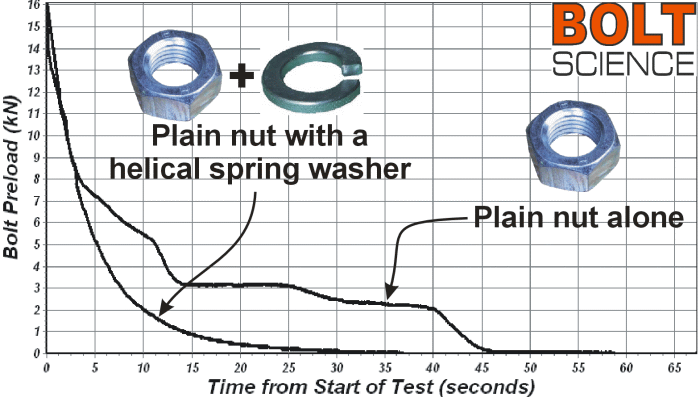
With all the other choices out there to help secure the fastener I stay away from split ring lockwashers. Instead there are nylock nuts, crimp nuts and my favorite - loctite brand threadlockers.
About the only thing I'll add to this area is that if the OEM fastener has a split ring or flat washer (or both) on them then use it the way it was designed and torque with them in place. Otherwise, choose a better performing alternative to this mostly useless item.
Here is the short version of the above:
- Use OEM fasteners whenever possible
- Do not change bolt (or nut) grade or class without attention to torque changes
- Replace worn or possibly stretched bolts with new ones
- Install Clean & Dry (unless otherwise indicated)
- Torque your nuts and bolts properly
- Know and learn the proper application of locking fasteners (washers, nylocks, etc)
Related Pages and Additional Materials
LOCTITE INOFRMATION AND APPLICATIONS
I hope you found this information useful. I pretty much just typed this all out at one sitting so if there's any typos or mistakes I missed let me know!
Cj
(later I will try and do a writeup on gasket sealants and case gasket makers!)
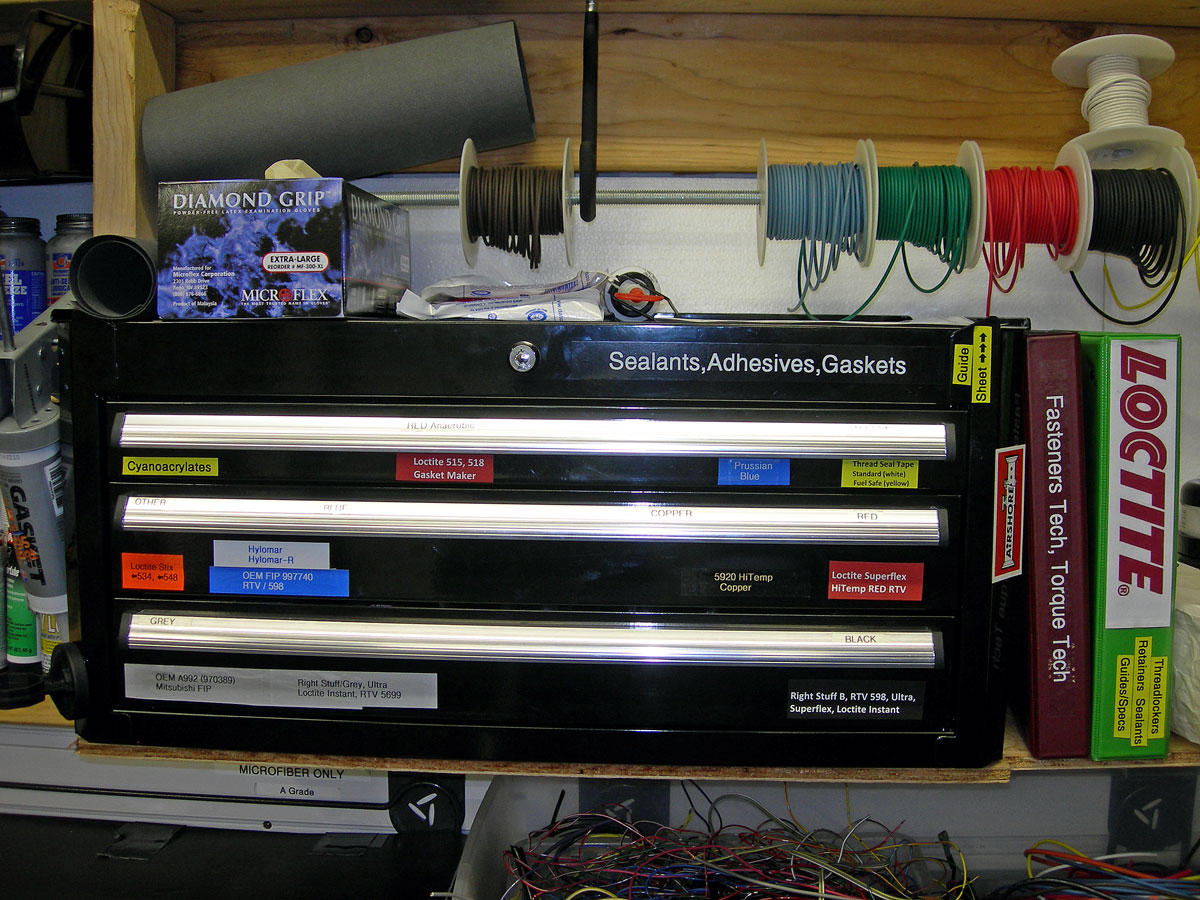
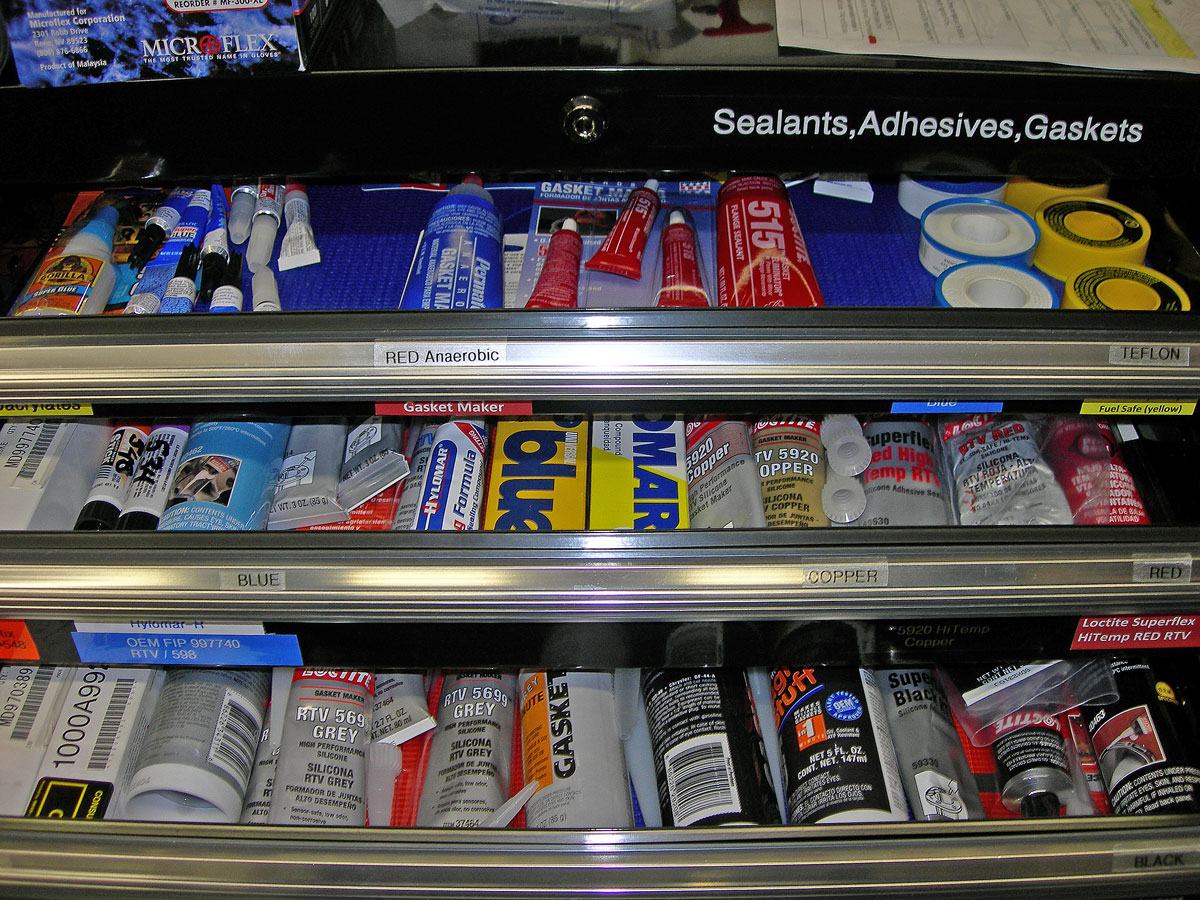
If this article interested you will like the performance build article below
| Performance Guide and Upgrade Lists / Advice | Loctite info | 60k/120k/180K info |
| My 95 VR4 | My Drag Racing 3000GT | My 3000 Water Injection | NW3S FORUMS |
| Exhaust Cutout | AEM Brief | My 3000 Stereo System | My Shop |
| Overheating troubleshooting and Coolant System info | |||
©cjbyron.com 2012